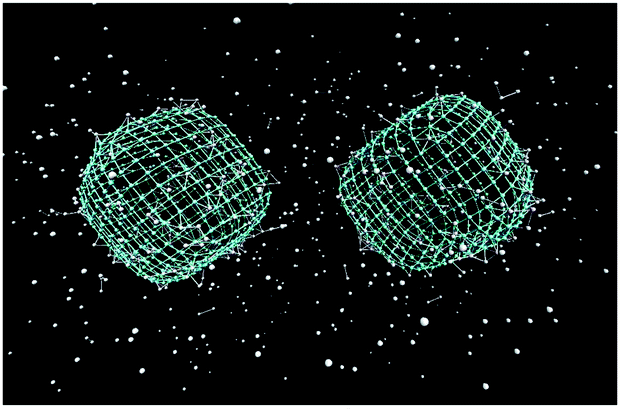
My first project was based on an intriguing experimental observation in hollow, colloidal silica cube suspensions: on average, they seemed to show some preference for corner to corner or edge to edge alignment in self-assembly. Together with the originators of this observation, Frans Dekker and Albert Philipse from Utrecht University, we investigated the electric field and potential of mean force of these colloids and showed that there is a pronounced orientational dependence of the particle interactions- in other words, the cube-y-ness affects the self-assembly process!
We published these findings (and more) in Soft Matter, available in Open Access here, with a more detailed version in my Masters’ thesis available here. The video from which this post thumbnail was taken is available here– for legal reasons, it is not set to the Star Wars opening theme, although I strongly feel this should have been a valid creative use.
 Margaret Rosenberg's website